|
One year ago there was a stunning report in the Syracuse Post Standard, headlined: “Wary of hospitals, pregnant Black women in Syracuse look to doulas.” This article went on to report a finding of Mariel Rivera, a certified doula and SU doctoral student, that “the statistics show that even if you are a Black woman with a PhD, the likelihood is that a white woman with a high school diploma would survive pregnancy and childbirth more than you would.”
Pregnancy and childbirth is a wonderful, but arduous, journey for any woman without the added burden of systemic racism. For many Black women, pregnancy and birth are a matter of life and death. The Centers for Disease Control and Prevention reports that Black women are 2 to 3 times more likely to die in childbirth than white women. There are many reasons for this unsettling statistic. Even though maternal deaths are considered mostly preventable, Black women develop cardiomyopathy, pulmonary embolism, and high blood pressure at a higher incidence than do white women. In addition, pre-term births are one of the leading causes of infant deaths in the world, and are highest in Black, Pacific Islanders, and Native Americans. The World Health Organization reports about one million children under the age of 5 die because of complications due to prematurity. Prematurity increases the chances that a child will have a serious disability or a chronic medical condition. The effects of prematurity even linger in many adults. Researchers have been working to tease out the many reasons for these disparities. One reason that remains is that gynecological therapies were developed by using enslaved women for surgical experimentation. Illogically, to this day implicit biases remain so that many medical providers believe that Black women feel less pain than white women, or that they take less care of themselves, or that they are more lax in following medical advice. In the USA access to adequate medical care is dependent on gender, wealth, race, and sexuality. The effects of historic red-lining practices remain. In Rochester, N.Y., birth certificates between the years of 2005 to 2018 reveal that the neighborhoods with the greatest number of babies born prematurely corresponded to old red-lining maps. Access to medical care, grocery stores, clean air, public education, and good jobs, remain limited in historically redlined neighborhoods. An interesting, sort of wonderful story, in all this is that last year, a medical student and illustrator, Chidiebere Ibe, tweeted a picture of a Black fetus within the womb of a Black mother. It was the first medical illustration of a Black mother and her unborn baby that most people had ever seen! It went viral. Interested in learning more about these issues? Take part in our upcoming meeting, "Structural Racism, Medical Racism, and Health Inequities: The Work of Dorothy Roberts" — Louise Brown Smith 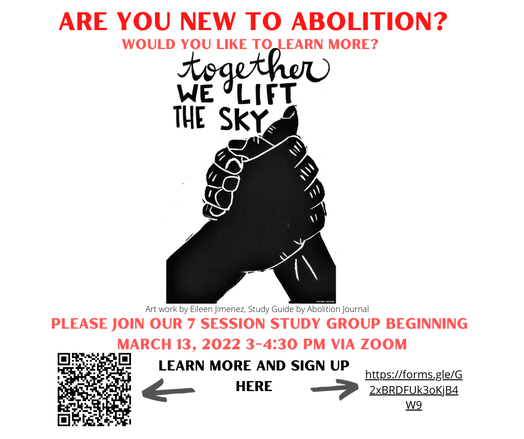 Every Third Sunday, Mar 13–July 10, 2022
3:00-4:30 PM EST What does it mean to be an abolitionist in 2022? Advocates describe it as both a dismantling and world-building work to create communities that are just and safe, that are free of prisons and police. It's a bold vision that abolitionists say requires complete community transformation and, as Ruth Wilson Gilmore states, "building life-affirming institutions." This study group is titled "Together We Lift the Sky" and is designed by the Abolition Journal. It offers a seven-session study group guide for people who are new to abolition. Reading prep (podcasts, short essays, videos etc) will require up to 5 hours of reading and reflection per session. Register now and share with others who are interested in learning about abolition and antiracist community building! Co-sponsored by ARC-C, HAARC (Hamilton Area Anti-Racism Coalition), and the National Abolition Hall of Fame. |
Archives
April 2023
Categories |
 RSS Feed